South Korea really is a spellbinding country. A cultural melting pot, it offers travellers the chance to experience all the colour and chaos of contemporary cities as well as discover an epic history dating back to the 1st century and beyond.
An old Korea proverb reads, ‘Even if you have to crawl on your knees, get yourself to Seoul’ and I would argue the same for the rest of South Korea. At once it is a country on the forefront of major technological advancements and yet oozes a historical mysticism: here you’ll find everything from teahouses and temples to skyscrapers and sweeping mountains, Buddhism, bars and the infamous K-Pop. Needless to say I couldn’t wait to see for myself all that South Korea had to offer (and I only really scratched the surface) …
Day 1 – After a short bus journey from Incheon airport I arrived at our hotel and to an utterly breathtaking eyeful of South Korea’s capital city.

A view over Seoul from the Grand Hyatt Hotel
Ever the sophisticated traveller I was very excited to discover the presence of a magic toilet in my bathroom.
My first evening in Seoul I made for the city lights, but not before enjoying a hearty dinner of chi-maek (chicken and beer). Despite what it sounds like this is actually quite a traditional meal for many Korean’s, particularly as a post-work social with colleagues and friends.

Chi-maek: tradition I could get used to
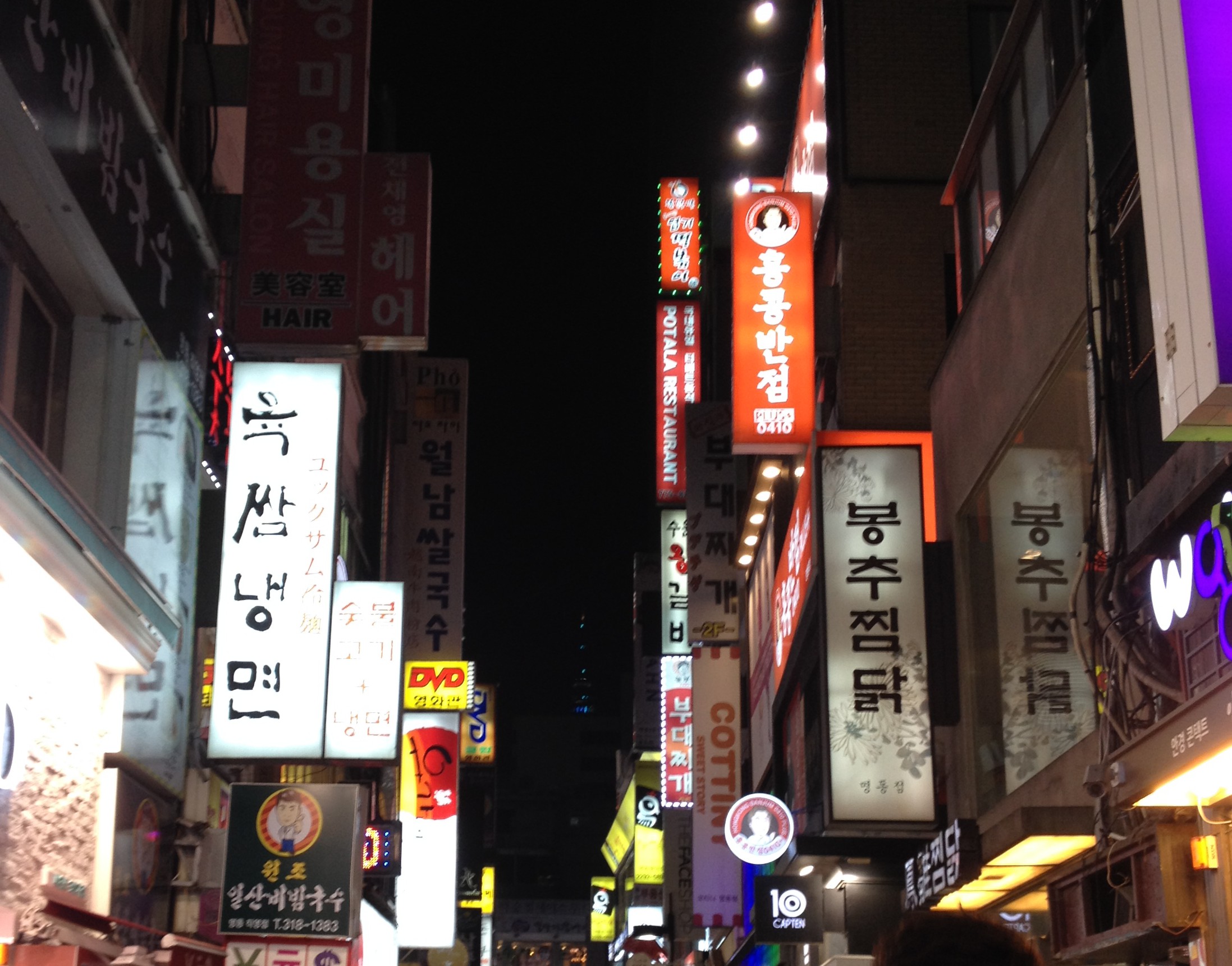
On to the Myeong-dong shopping district and to those iconic lanes of bright neon lights. Here you’ll find all sorts from clothing boutiques to gadgets stalls, and a bizarre amount of vendors selling socks. But the real draw is the feast of delicious street food – we’re talking sweet stuffs, savoury snacks and seafood galore!
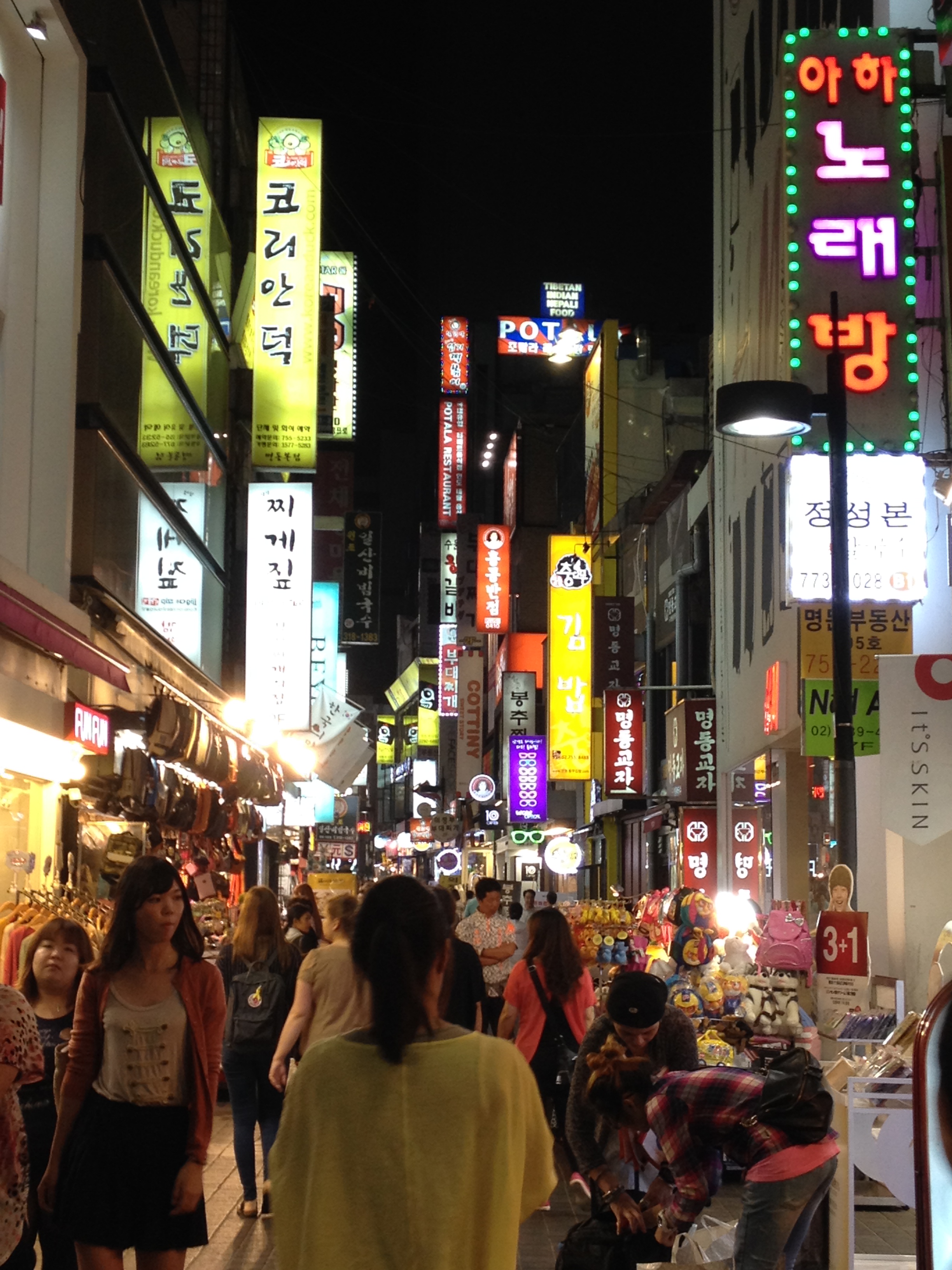
The bright lanes of the Myeong-dong shopping district

An array of tentacles
Safe to say I did not brave the octopus tentacles and miscellaneous bits of sea-creature, despite a kind offering from the vendor to deep-fry it. But watching this cheerful chap make Yong Su-Yum (Dragons Beard), a kind of fluffy, sugary parcel filled with nuts or chocolate, was a real treat – and they were delicious too!
Day 2 – The second day took me out of Seoul and to the historical capital of Gyeongju. And what better way to travel than by Korea’s KTX Bullet Train. Next stop, Gyeongju!!!
…not before snapping a picture of this unusual vending machine I found in the station!
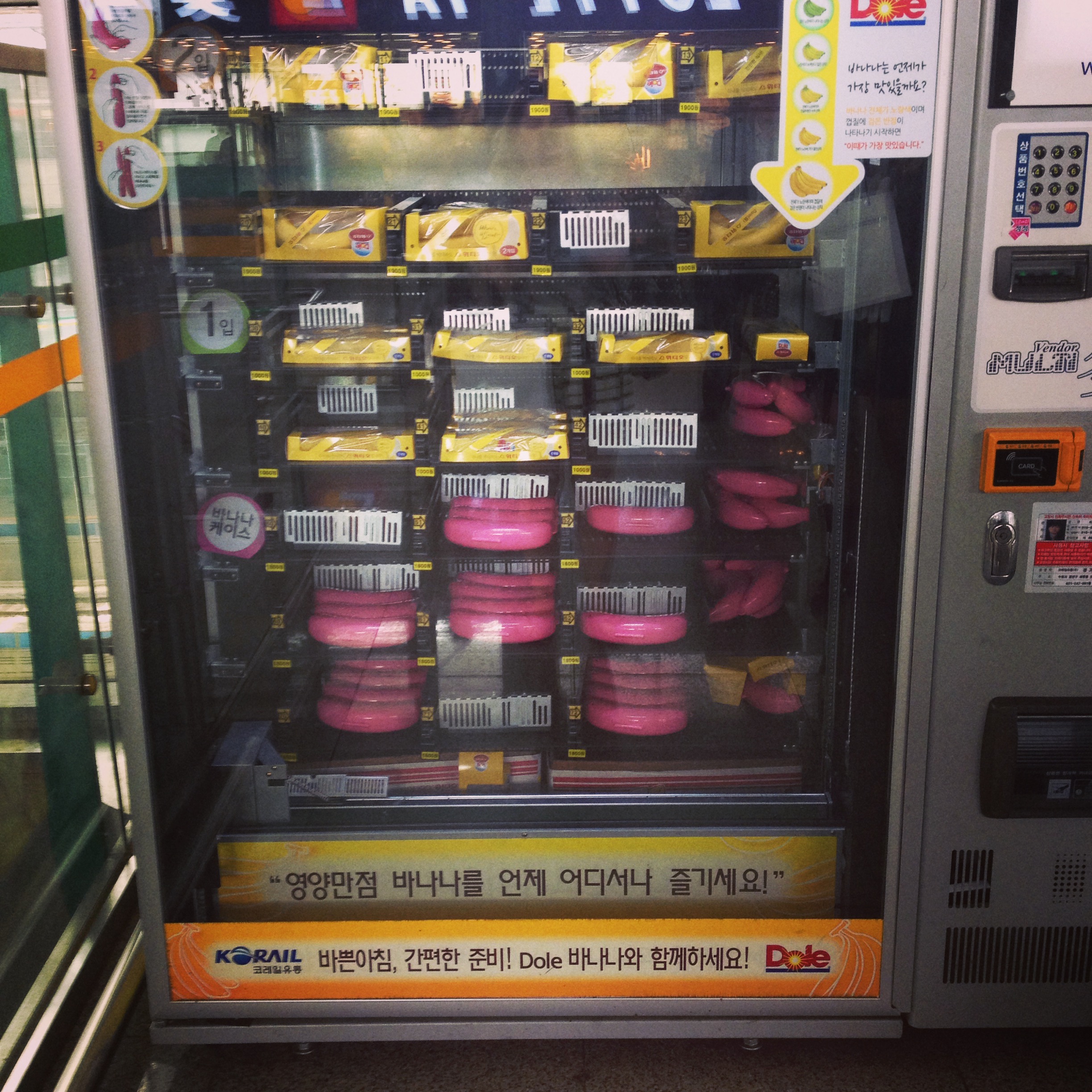
A banana and banana case vending machine
Gyeongju was a world away from hustle and bustle of Seoul, full of ancient sites and Buddhist temples it felt as though I had travelled back in time to a bygone era. The first stop was Anapji Pond, the former grounds of the Donggung Palace, one of the main palaces from the Shilla Kingdom (57AD-935AD). Although the palace doesn’t exist any more, the ornate pagodas, manicured lawns and picturesque pond swimming with lilly-pads and shimmering koi carp, certainly give you an insight into the splendour in which the rulers of this ancient dynasty lived.
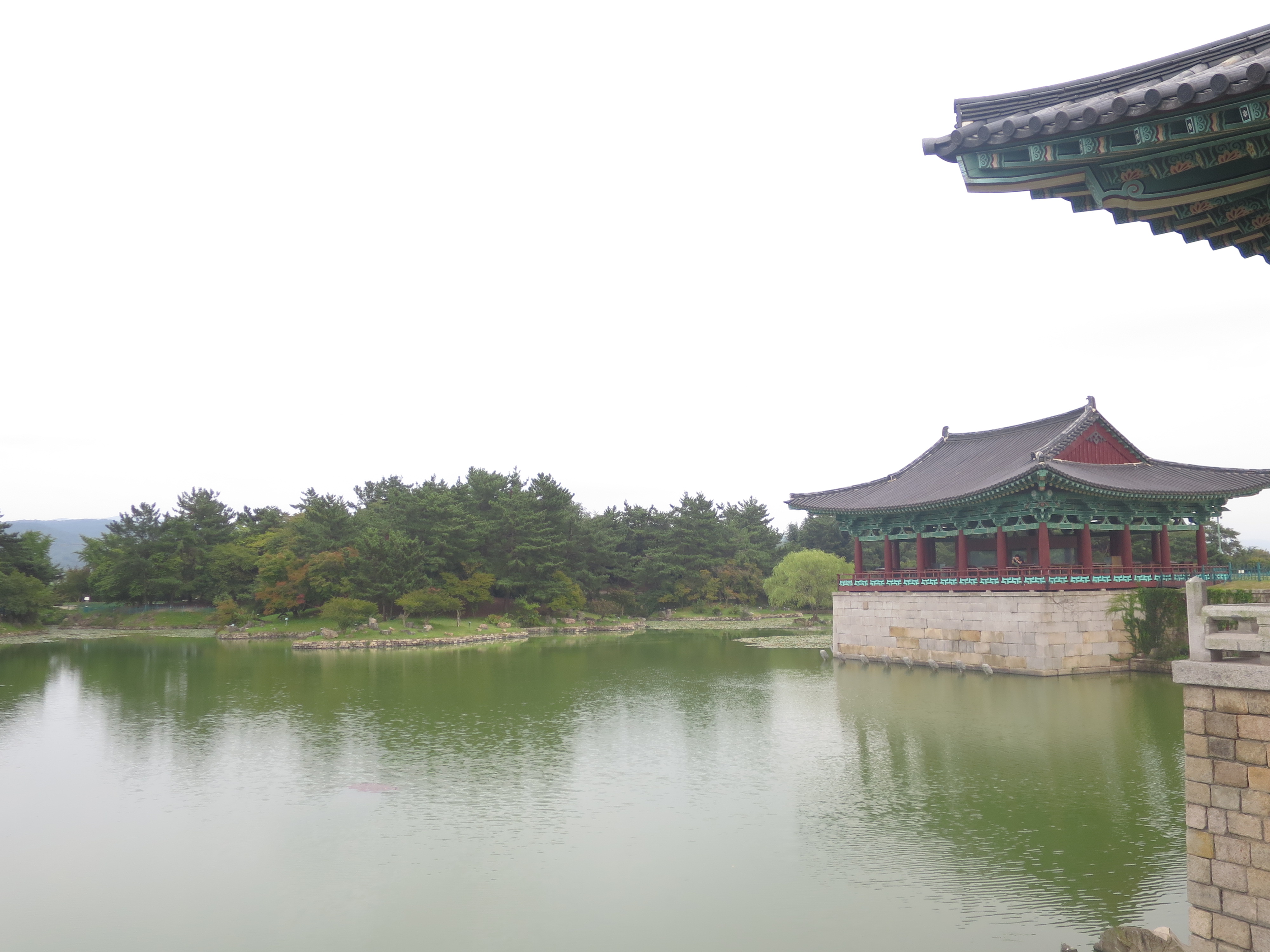
Anapji Pond and pagodas

Coy carp in Anapji Pond
And after a long and luxurious life many of the Shilla rulers end up here, Tumuli Park, buried beneath these mounds along with all their weapons and finery. A real highlight is the Cheonmachong tomb which has been excavated to allow visitors inside.

The entrance to the Cheonmachong Tomb

A burial mound of the ancient Shilla rulers
My rest stop for the night was the beautiful Ragung hotel. Designed in the traditional Korean hanok style each suite had its own living space, ondol room (room with underfloor heating) and private plunge pool. It was hard not to feel like Shilla royalty yourself.
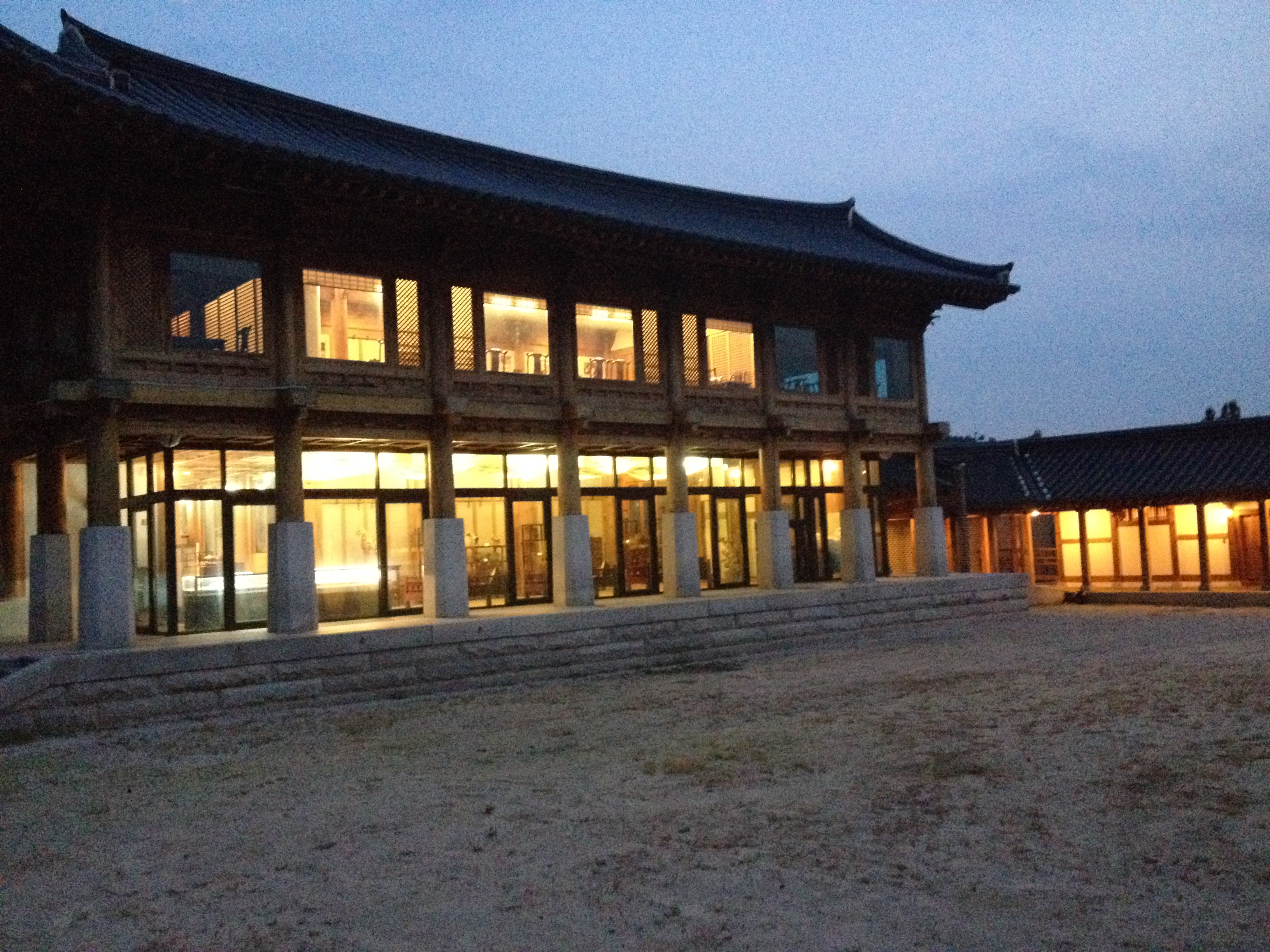
Ragung hotel
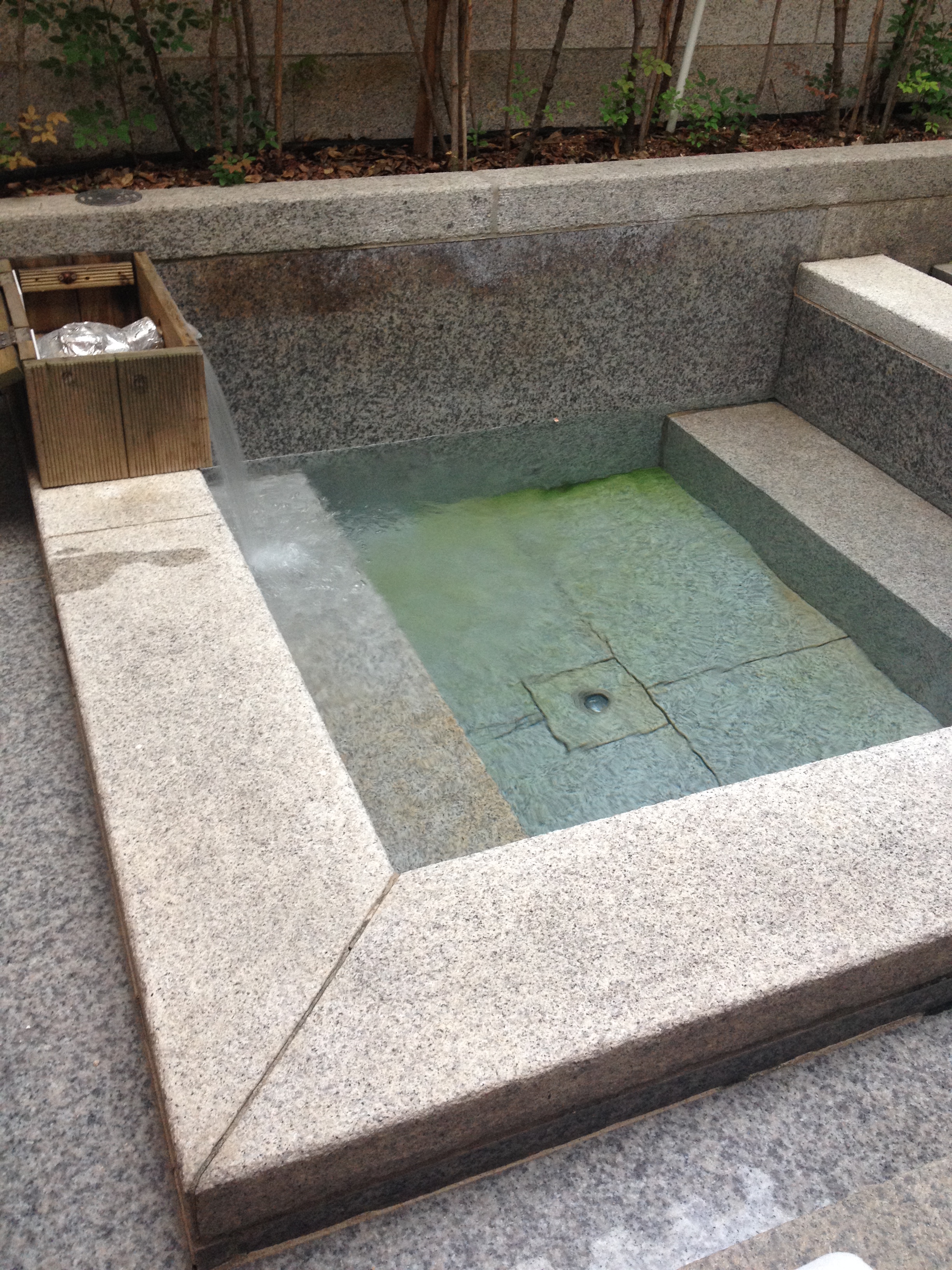
Plunge pool
There was just time for a quick dip in my personal spa (travelling can be so tiresome after all) before heading off to the hotel’s restaurant for some traditional Korean cuisine.

Take a bit of each ingredient and wrap it in the yellow pancake. A hard task with chopsticks!

Duck pancakes and smoked salmon
After a glass or two (too many) of Soju it was off to bed, to rest up for another day exploring Gyeongju’s fascinating historical and cultural heritage.

Soju
Day 3 – Up and out early I made for Bulguk-sa, a sprawling Buddhist temple on the slopes of Mount Tohamsan.

Guardians at the gate of Bulguk-sa

A tourist snaps a shot of Bulguk-sa
Buddhism isn’t such an actively practiced religion these days but Korean’s still hold its values and customs in high regard. Because of this Bulguk-sa can get busy with school groups coming to learn about the religion, but a well timed visit (early morning is the best) can help with avoiding the crowds. It was quite a awe-inspiring experience walking around stone terraces, marvelling at the incredible architecture and designs of the temples, and we were fortunate enough to witness the resident monks attend their morning prayers.

A monk attends prayer
Day 4 – No rest for the wicked as after returning to Seoul I hit the road once again, this time heading to the Demilitarized Zone. No buses or trains for me though, Kia (Seoul based motor group and my expert guides on this trip) were kind enough to let me test drive one of their new models on route to the DMZ.

Me and my sweet ride, the Kia Soul
The DMZ was a truly bizarre place. Despite being the most heavily fortified border in the world it is awash with the excited chatter of school groups, tourists and souvenir shops all kept in check by an ever present militia. Tours are strict but insightful, taking you up to the JSA, down into the tunnels and to visit villages caught in the midst of the conflict. An awesome check point is the Dora Observatory where you can get a once in a lifetime view over North Korea.
This picture looks towards Kijong-dong, a propaganda village built by the North Koreans in an attempt to appear to be matching developments in South Korea. The blue-ish pole in the distance is the world’s third largest flag pole built as a result of what some have dubbed ‘the flagpole war’ with their southern cousins.

Looking towards the world’s third largest flag pole
Weird and wonderful. I couldn’t resist bringing back a little slice of the DMZ.
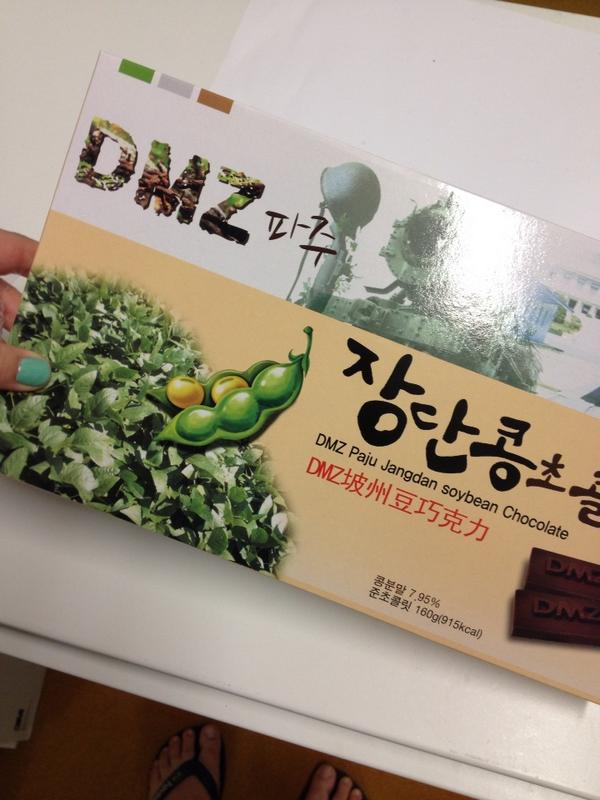
Chocolates from the DMZ
After a four day whirl-wind tour of South Korea past and present, I had one iconic experience left to try, Seoul’s infamous LP Bars. Walls stacked high with LP records, containing more music than you could comprehend – and boy did I make the most of it (well if you consider bopping to an array of 70’s and 80’s classics making the most of it).

LP Bar
Reflecting on my trip I couldn’t help but feel South Korea is a somewhat misunderstood country. Often attributed the same reputation as its less favourable northern neighbour it can get overlooked for more mainstream Asian destinations like Shanghai or Tokyo. But I think there should be a place for South Korea on every travellers bucket list.
Gyeongju was particularly fascinating; a whole town overwritten with a historical legacy I had only ever read about or seen in films. Except that this was no film set – although there is something quite fantastical about coming face-to-face with a 4m tall Buddha sitting resplendent in a cave temple high in the mountains.
Seoul was a mesmerising example of how fast South Korea’s economy has grown and nothing will beat that first view of those iconic neon lights.
The DMZ however,I couldn’t quite place. It felt somehow caught between the past and present; part museum, part tourist hotspot it remains a stark reminder of a volatile and on-going political feud and of the progression that still needs to be made.
South Korea encompasses all those iconic experiences that you expect from an Asian destination; history,spiritualism, culture, cuisine, impressive landscapes and dynamic modern cityscapes. As my first foray into Asia, South Korea was a pretty amazing jumping off point and it’s safe to say it won’t be too long before I’m seeking the soju once again. A beautiful country in a beautiful part of the world; what more could a traveller need, eh?
I travelled to Korea courtesy of Kia Motor Group. I do not except freebies in exchange for positive coverage. Related articles: Time Travel in Gyeongju: Korea’s ancient capital.
 Generation Fishcake
Oh, I’m so jealous. I really wanna go to South Korea one day as I even speak some words (at least, I can introduce myself :D) Korean. It looks like you really enjoyed your time in Seoul. The city looks fantastic and very interesting.
Thanks Moritz. It really is a beautiful place and by my experience the people are really friendly so you can test out your Korean language skills!